Book Censorship News, July 24, 2026
What’s also concerning is how many lawmakers and board officials desire to make–or have made–these “tools” necessary ones for professionals to use to do their jobs. York County Library in South Carolina, for example, cites RatedBooks as one of the reputable sources library workers should use to make collection decisions (something that the partisan-designed site celebrates). At least two state legislatures tried to worm utilizing sites like RatedBooks as requirements for library acquisitions this year, too–Utah, where RatedBooks’s creator is cozy with some of the lawmakers, and West Virginia. Neither succeeded, but those won’t be the first nor last attempts.
Warren County Public Libraries (NJ) saw their county commissioners ram through a new policy that forced the public library system to share reviews of materials from BookLooks in late 2024. This move was not only about politics but also reiterated how slapdash and unprofessional these sites are: BookLooks wasn’t even around a few months after the policy passed. That, and other decisions made by boards related to BookLooks, only underscore how much time, energy, effort, and money are being wasted on right-wing agendas and how much disrespect there is for trained and skilled professionals.
Literary Activism
News you can use plus tips and tools for the fight against censorship and other bookish activism!
These unprofessional review resources strip away the legal meaning of obscenity, as defined by the three-pronged Miller Test. They also serve to further manipulate the law regarding materials available in public and public school libraries.
So, what are among the most favored and the newest review resources being used by book censors in 2026? Let’s take a look. This isn’t comprehensive, but it gives a sense of what’s regularly used and what’s being promoted as the hot new thing.
RatedBooks.org
Beginning with the oldest and most favored among the groups challenging books in public schools and libraries is RatedBooks. Owned by several “parental rights” groups, including Utah Parents United, No Left Turn in Education, and Facebook groups like LaVerna in the Library and her state-level sister pages Mary in the Library, RatedBooks.org is very similar to the defunct BookLooks in that it utilizes content ratings on a zero to five scale. It creates handy little guides to sentences deemed inappropriate by volunteer readers, and it offers far-from-objective views on whether a book should be accessible to minors.
Reviews on RatedBooks are updated monthly, and there is no real whim or way about how books are selected for review. There’ve been periods of time when the people behind the site–who insist they care about the books children read–have focused entirely on adult romance novels rather than on the so-called “inappropriate children’s books.” Professional review sites have a systematic way they do their reviews, and it’s not going into the backlist and picking out any title that seems like a good one to review that month. Because RatedBooks and others aren’t professional review sites, they can’t review titles that will be published in the future unless an author specifically reaches out to them.
Here’s how RatedBooks looks. Patricia McCormick’s Sold earns a five-out-of-five rating from the site, classifying it as explicitly inappropriate content that should be inaccessible to minors. This is the review.
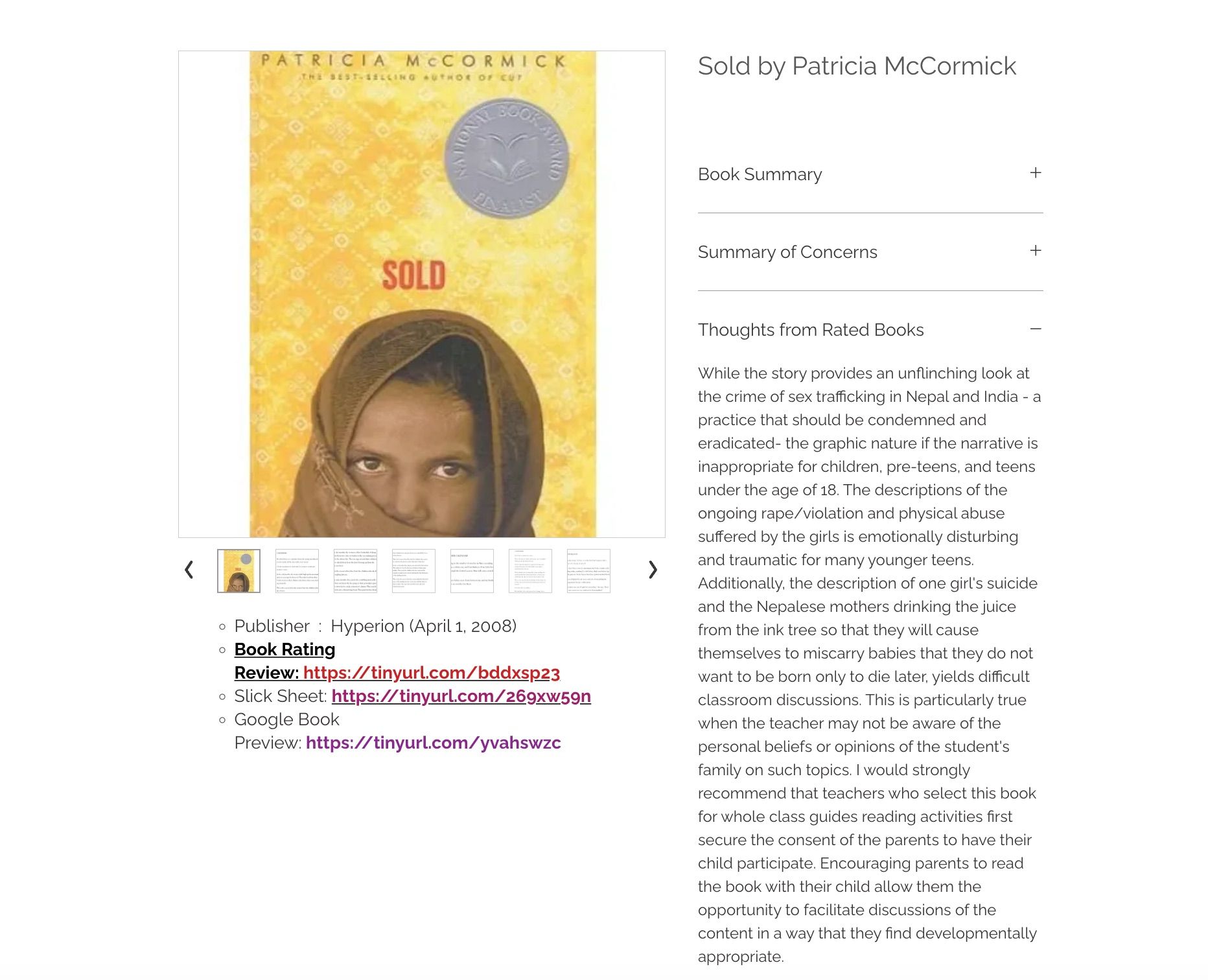
Not only is a very clear and singular agenda laid out in the review, but it’s also done in such a way as to be utterly patronizing to any educational professional.
[T]he description of one girl’s suicide and the Nepalese mothers drinking the juice from the ink tree so that they will cause themselves to miscarry babies that they do not want to be born only to die later, yields difficult classroom discussions. This is particularly true when the teacher may not be aware of the personal beliefs or opinions of the student’s family on such topics.
What’s especially interesting about this review is that it’s coming from the same party of people who continue to believe that America has a human trafficking problem that is mathematically impossible to have and that supports propaganda films that “expose” this issue, like Sound of Freedom.
When it’s brown kids in another country, though, it’s downright aberrant content.
National Book Rating Index
A sister site to RatedBooks.org, The National Book Rating Index is intended to create comparisons among book review outlets for parents to make “informed” decisions. It’s a subscription service, designed that way to offer a product that could be sold to institutions and to states that push through laws requiring “parental rights” review in book selection. RatedBooks wouldn’t be sellable; the National Book Rating Index, which can include reviews from RatedBooks, could be. Earlier this year, there was a clear rate for the site, with exclusive content available only to paid members. It now appears that all access is freely available.
Brooke Stephens, one of the people behind RatedBooks, is an owner of the National Book Rating Index. It’s a neat way for the partisanship of Utah Parents United to benefit from the very manufactured panic they created around children’s books. Capitalism always capitalisms, as it were.
Here’s the landing page for the National Book Rating Index:

There are three key categories you can filter books by, and two of them reflect books targeted since 2021. They’re books with LGBTQ+ content or books centering marginalized people (note the conspicuous use of the Black power image to denote the “CRT” boogeyman). Violence isn’t a surprise to see as a filter, though violent books are less likely to be banned from libraries in the U.S. than those with gay characters in them.
When you click on Ratings from the top menu, you’re presented with a list of the ratings tools used by the websites created by book censors. You won’t find where and how professional sources like Library Journal or Kirkus review books. Instead, you’ll get the information about how RatedBooks and BookLooks label; how the most prolific book banner in America rates books in his index; as well as other organizations like Christian Parent Reviews, Banned in Prisons, Compass Book Ratings, and more. All of these reviews and their subsequent book ratings are translated into a single score presented by the National Book Rating Index as the “National Score.” That scorecard is the same as RatedBooks”, and in the image above, you can see they’ve designated what those scores mean in terms of their ideas of “appropriateness” for young readers.
Next is the Audits section.

Not only does this provide a link for people to copy and paste their complaints to their local schools and libraries. It doesn’t even try to hide the fact that the ratings and reviews only center conservative viewpoints. This isn’t about “moving the conversation from cultural rhetoric.” It’s about making conservative beliefs and values the only ones allowed in public institutions. It is about curating a public that looks only one way.
For $100, you can get a whole library transparency package.

Things get more interesting when you click the Lists tab. Five different states are available in a dropdown menu for you to choose from: Arizona, Florida, Michigan, Texas, and Utah.
Clicking on Utah, you’re taken to a list of schools where you can access what appears to be a dataset of all the books available in the individual school libraries. Where and how would an index like this have access to a full library inventory? This is information that a library worker retrieves from their cataloging software; it is not available to the general public (it is possible, however, that in states where laws now require parents to have access to the school library’s full catalog, such a file could be used to fulfill legal requirements). And for the price of $10, the National Book Rating Index will send you a letter with instructions on how to get your library to create these lists for you so that you can train the system meant to ban books nationwide.
These lists have been run through the National Book Rating Index to check whether or not book titles in those collections align with conservative values. If not, it appears that’s the trigger to begin the challenge process and/or “empower” the parent who just spent $100 to tell the school librarian their kid can’t borrow those books.

Here’s a link to the Google Sheet linked under “view inventory list” for Syracuse High School. The first tab is fascinating. For all of the years’ worth of claims that books aren’t being targeted for LGBTQ+ content, the actual notes in the database tell a different story.

This spreadsheet isn’t necessarily documenting that the books have been removed from Syracuse High School in Utah. It documents the books available in the school that have been rated by the National Book Rating Index and that have been banned or challenged somewhere in the United States. (Learning that my book, Here We Are: Feminism for the Real World was banned because of “LGBTQ” doesn’t surprise me, but it sure is something to see it presented so shamelessly). The National Book Rating Index “borrows” the information about book removals and challenges from PEN’s annual indexes, as you’ll see below.
Continuing across the top list of links on the National Book Rating Index landing page is “Testimonials.” As of writing, it includes one school board member in Arizona who is glad she can easily run book lists through the index to target books she won’t bother to read but wants removed anyway.
The second-to-last tab is about how the National Book Rating Index is a product of S&S Apps LLC–that’s Brooke Stephens and her husband. Not only can this family benefit from banning books, but they’re also cashing in on the service to make it easier to ban books across the country.
The final tab on the landing page is the Kids’ Index. This is for young people who are eagerly logging into the National Book Rating Index to decide whether to pick up a book. This section has the same book reviews as their index, but it’s filtered so the “naughty” and decontextualized passages teased out in the main reviews don’t show up here.
Let’s take a look at what the Index looks like when you search for a title.

It’s a list linking to all the conservative “reviews” included in the National Book Rating Index. You can see the ratings and how those translate to the Index’s belief about the rating. Below the reviews, often copied and pasted to challenge titles, is a generic link to “industry reviews”–also known as the ones done by actual professionals. For Sold, that’s a 40-page Google document including the reviews from several publications, as well as instructional guides for teaching the book.
It’s a hell of a contrast between the reviews that pose as “exposing the truth” of the novel and the actual reviews that show where, why, and how the novel is useful in educational settings and why it is age-appropriate.
Showcasing the conservative reviews as quick-hit links with numbers and pull quotes on top, then including a 40-page guide with actual reading and thought required, is far more telling than it probably intends to be. People don’t want to sit with lengthy texts, which is precisely what the Index and similar sites bank on to begin with. But those who do spend time with those meatier texts discover actual research and insight beyond some passages intended to capture attention.
Also on this title is a “C” and an “X” at the top, indicating the book has both been challenged and removed. The National Book Rating Index makes it easy for you to see this by simply slurping the PEN America tracking information into the entry:

I put in the name of a trans author who writes books centering queer characters. You’ll notice that the only books not labeled with the scary LGBTQ+ label and not deemed inappropriate are the picture book about feelings and the one about vegetables.

If you want to utilize the audit system to inform your local librarian of the books you don’t want your kids to have access to in the library (and thereby “preserve parental authority”), you can get help with that, too. Check out the design of the greenlight letters. Nothing says professional more than AI-generated images like this.

“Simply sign the Greenlight form and ask the librarian to review the title on the NBRI before allowing the child to check it out. If the rating or sensitivity matches what you select on your form, then the librarian contacts the parent to review it before allowing the student to check it out.”
Library workers now not only have to navigate the professional side of their jobs, but they also have to navigate an entirely new one.
BookLens
Developed by Citizens for Decency, book banners have been promoting BookLens.org as the way forward for helpful information about why any book should be removed from shelves. Citizens for Decency is an anti-pornography nonprofit, so the focus of this tool is about highlighting all of the “naughty” stuff lining library shelves. You know, the kind of stuff that’s way worse than whatever a person has available to them in the little computer they carry in their pockets everywhere.
There are three ways to search BookLens. You can do it by scanning the cover of the book, by the ISBN of the book, or you can do a manual search by title or author. BookLens is built entirely on Artificial Intelligence. As a result, it hallucinates. That makes it the perfect tool for lying, as you can pull up reviews that emphasize how much sexual content, how much queer content, and how much profanity is in anything–even books that don’t actually exist. If BookLens is creating panic around books that don’t exist, you can imagine how reliable it is about the books that do exist.
Let’s look first at a book that does exist, That Librarian by Amanda Jones. This is a work of adult nonfiction that would certainly be in plenty of public libraries, as well as likely in several public school libraries (primarily, if not exclusively, in high schools–though it could be in teacher collections at lower level schools).

There’s nothing “naughty” in Jones’s book, but ultimately, what’s the point of this review at all? There isn’t one. A person looking for information about the book would get more by simply going to Amazon; they could also consult any review source to find what they’re looking for.
So, how about a search for Patricia McCormick’s Sold?
It simply takes you to the “book report” from the defunct BookLooks, presented as a Google Doc. This strips away the provenance of the review, and it doesn’t present the same kind of screen as the one for Jones’s book. That is, you only get the BookLooks review and no alternate sources for information.
Earlier, I noted that this tool hallucinated books. It appears as though between the time of the tool being developed and the writing of this piece, that’s slowed down. But you can see a brilliant example of this from author Ryan Estrada, who made up the title of a book, and the results from BookLens were a fabricated list of ways the book was wholly inappropriate.
It’s wild to say that, because the information is so decontextualized from BookLens, it’s a useless tool for anyone seeking to ban books. Beyond providing them the BookLooks report, what else does it provide the would-be banners? There are no actual tools or resources. It’s a little more than whatever the robot wants to give out, but because of how little else there is to it, why should anyone care? It’s a sign of how sickeningly obsessed so many people are with AI that they’ll use it even–especially–if it has zero purpose. Rather than walking 10 feet to toss their trash in a garbage can, these are the people who open their car window and let it fall to the ground.
BookLens is worth being on your radar if for no other reason than it might provide some funny results about how much sexual content there is in books that do not exist. Sometimes finding humor in the darkness helps.
Take Back the Classroom
Covered extensively last November, Take Back the Classroom remains a favorite resource for finding books to ban.
Unlike other sites, Take Back The Classroom (TBTC) used high-quality images and highlighted the sentences or paragraphs deemed offensive. The physicality of the books being used separated them from the plain documents of other groups, though downloading the plain documents was available for book banners as well. From the start and to this day, England notes that what differentiates Take Back the Classroom from other sites is its refusal to assign ratings to titles. They’re more interested in providing all of the material necessary to get the average person filing challenging without having to do a lick of their own work.
While TBTC provided all of the tools for followers to begin their school harassment campaigns over these books, one of the hallmarks of the site that differentiates it from others is that it catalogs the locations of these so-called “inappropriate” or “pornographic” books. Schools that have them on the shelf are named.
By creating an index of schools with these books, local book banners are better able to target and shame those institutions. They don’t need to locate the books in their school’s library catalogs, which requires a few minutes of work. That’s already been done.
Next month, the folks behind TBTC are launching a new effort to help make book banning even easier. Here’s the key piece from the email they’ve sent out about it:

The goal is a database of “proven strategies” that have gotten books removed from schools. Masks have always been off, but they’re going to be getting even more aggressive with the new school year.
Here’s the form, if you’re curious. It’s certainly collecting a lot of personal data alongside the information about where and how books have been successfully removed.
What Else
These are not the only tools being used by book banners. There are numerous others, though these three are the biggest and/or most hyped at the moment. Some others include:
Each of these is designed to highlight what one group believes is inappropriate and worthy of being challenged in public institutions, or it is designed to stigmatize already vulnerable people through its review and ratings systems (i.e., labeling LGBTQ+ books). Not included in this roundup are sites meant to actually help parents find books they want their young readers to pick up–these guides can provide a useful service for many who are looking for a specific kind of book, and their intent isn’t to do direct harm.
Book Censorship News: July 24, 2026
- The Anderson County Library Alliance (TN) is suing the county and its library board over talk of banning books.
- The Conversation talks about what’s lost when everyday stories of Black people are banned across the country.
- “Reporting from the Brookings Register covers some of what was said about some of the books at the June 7th Brookings County Commission meeting, including phrases such as “Pornographic Filth” and “God’s children are not for sale.”” Despite people showing up to complain about books at the Brookings, South Dakota, county commission, the library hasn’t actually received any formal complaints. The library director points out how the folks complaining don’t want to use any of the tools already available to them, which is a reminder that the rules don’t apply to conservatives who scream victim the loudest.
- Authors in the UK are having their school visits canceled, too, over complaints of their books acknowledging gay people exist.
- Librarian Amanda Jones delivered a keynote to the Libraries Connected annual symposium in the U.K. last month. You should absolutely read it in full.
- Somerset County (MD) schools are wanting to implement one of the worst book bans in the country by limiting access to YA books for anyone under 18. This, despite it being a state with a freedom to read/anti-book ban bill, of course. A Black father is suing the conservative school board now for its lack of transparency, how they’ve handled his public comments, and their desire to censor the library.
- The Monroeville library’s (PA) Pride Month display puts regional fight over LGBTQ+ books back in focus. It’s hard to understand how there is a “fight” over queer people existing or not.
- An international censorship story that’s been evolving over the last few weeks is this one: Indian authorities are mass censoring libraries and schools in Kashmir, claiming they are filled with “objectionable” content. This is a region with significant geopolitical dispute, and the “objectionable” content here is anything associated with the pro-freedom movement in Kasmir.
- Alberta, Canada’s government is requiring schools be in compliance with their new book ban laws by the start of next year.
- Complaints out of people served by the Timberland Regional Library (WA) about one of the branches having a Pride Display includes a gentleman foaming at the mouth because he claims librarians there didn’t know the “children’s classics” “like Frankenstein, or Huckleberry Finn or Tom Sawyer.” Yes, yes, that children’s classic Frankenstein. Never heard of it. Good grief–it’s yet another sign of how the library board’s president has not been shy about his goals of “beiging the library,” rather than tackling actual issues in the system.
- Two conservative law firms are joining the Elizabeth School District (CO) to defend their right to book banning.
- The Knox County (TN) school board will revisit their own policies related to book banning, following the removal–and return–of Roots from library shelves. At this week’s meeting, they talked about updating their vetting process and that they might reevaluate all 123 books they’ve banned.
- A federal appeals court said that an Oregon educator’s First Amendment rights were not violated when he was fired by having gender essentialism books on display while students were present. This is a big deal–the displays were in violation of the school (and state’s) nondiscrimination policies. Where and how this ruling will apply to public institutions focused on inclusivity, including diverse book displays, will be worth watching.
- “Members of a Florida county school board asked an 11th Circuit panel Wednesday to quash subpoenas seeking depositions on their motives behind removing and restricting over 100 books within the district’s public libraries.” The amount of effort that Escambia County board members have spent trying to get out of having to have their voices on the record for this is not small. If there were no issues, there would be nothing to try to hide.
- The Fontana Regional Library Board of Trustees (NC) is updating their collection policies for public libraries in the system and it’s deeply disturbing. There’s a whole section on “balance” when it comes to “trangenderism,” among other things. From the article, quoting a footnote in the policy “Teen fiction has a higher percentage of trans fictional characters than are present in the general population, but Teen fiction lacks characters dealing with the aftermath of puberty blockers and gender surgery.” Sigh.


